

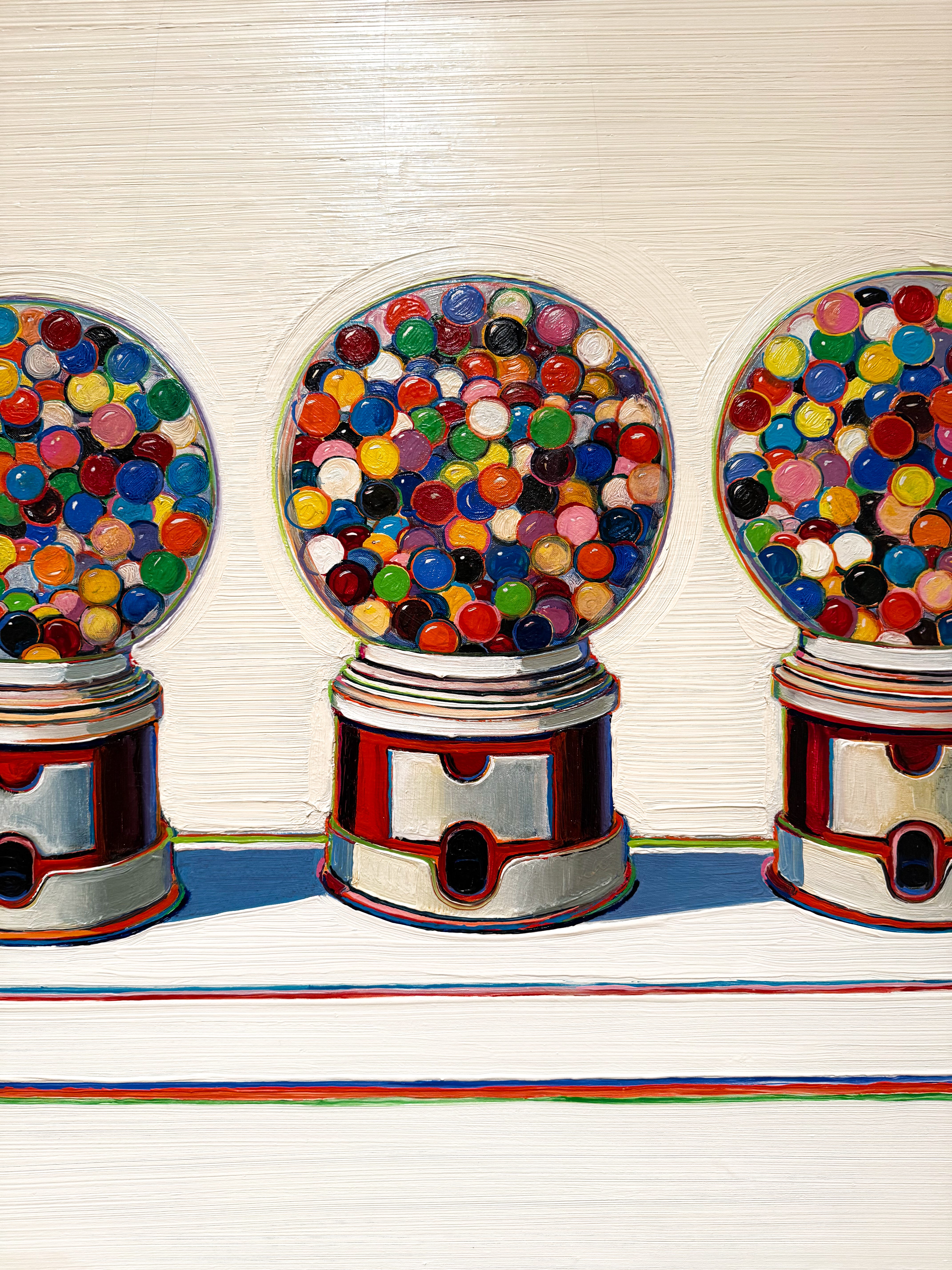
Hello. I’m breaking my Substack virginity by writing about Wayne Thiebaud, an artist whose work is as seductive as it is contemplative, and far more layered than it is often given credit for.
Thiebaud has recently re-entered the consciousness of Londoners thanks to the exhibition that has just wrapped up at the Courtauld. This piece is very much a result of that encounter. I’m an artist and an architect, and until now I had never seen such a comprehensive body of Thiebaud’s work assembled in one place. Seeing it presented in this way made something click. What I was observing was not mere nostalgia, kitsch, or even Pop in the Warholian sense, but a far more rigorous, uneasy, and quietly political practice.
American Still Life
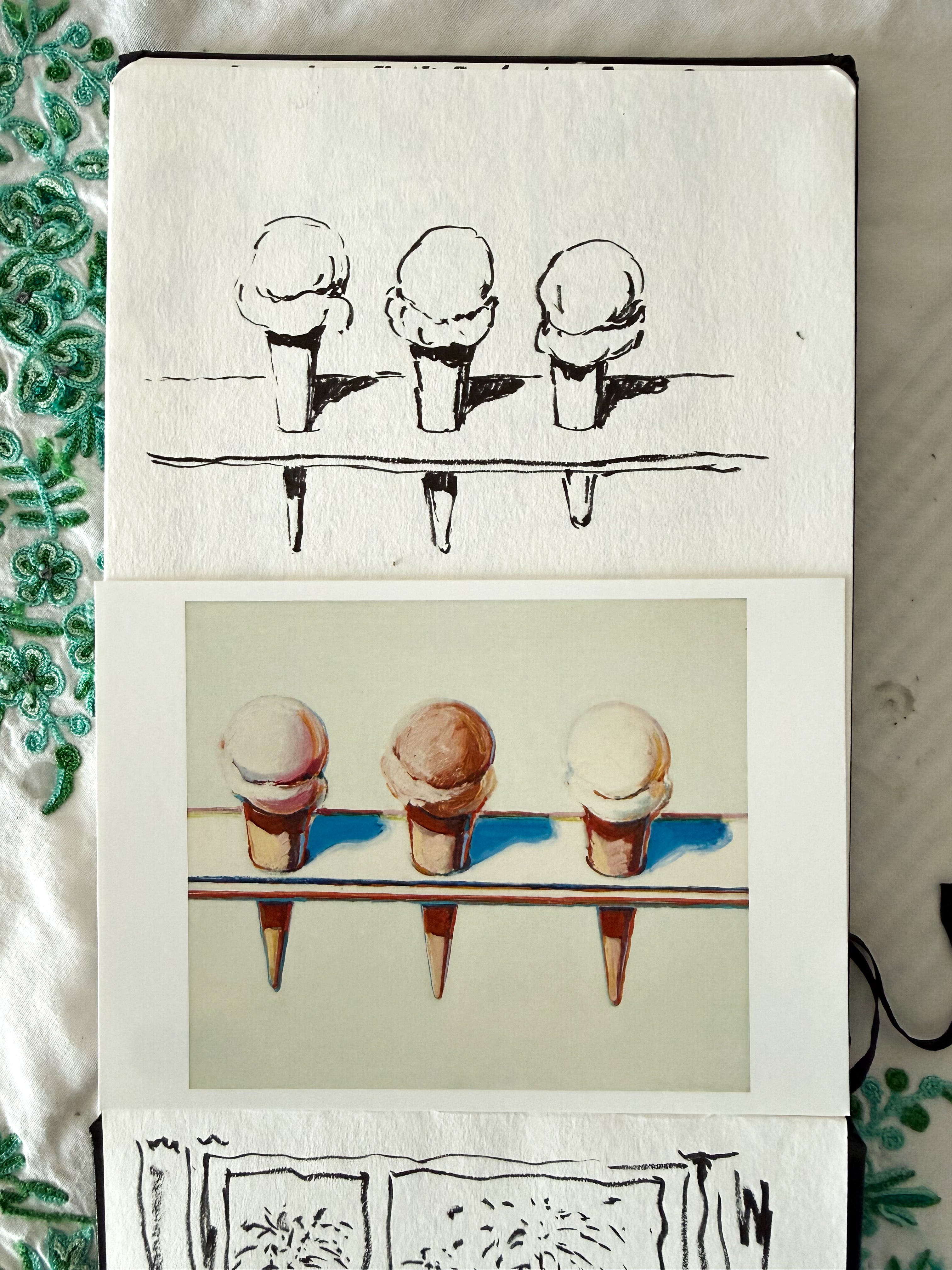
One thing that became immediately obvious in the exhibition is Thiebaud’s contribution to still life painting. Of course, America had still life painters long before him in the likes of Georgia O’Keeffe, William Harnett, Raphaelle Peale, but I would argue that Thiebaud was the artist who made still life distinctly American. Where earlier American painters remained in dialogue with European traditions, enriching and extending them, while searching for a national inflection, Thiebaud delivered something far more decisive. He did not merely adapt the genre, he recoded it.
Working from the 1950s onwards, Thiebaud painted a world shaped by postwar optimism, anxiety, abundance, and anticipation. He has been described, half jokingly, as the “poet laureate of the coffee break”. Yet his paintings of the everyday are anything but casual. They are not snapshots of life, they are constructed, deliberate, and intensely focused.
Thiebaud frequently cited Giorgio Morandi as a key influence, particularly Morandi’s ability to transform humble objects into something almost sentient. Morandi’s bottles become characters, his tabletops become stages. Thiebaud does something similar. His cakes, pies, gumball machines, and counters are not props, they perform. They sit in silence, charged with personality, tension, and emotional weight. Like Morandi, Thiebaud understood still life as theatre. The list of artists Thiebaud thus borrowed from is long, and spans Impressionists, Post Impressionists, Expressionists, but what matters is what he did with those influences. He filtered them through a distinct Californian light, American abundance, and commercial precision. The result was unmistakably his own.
His painterly sensuality, thick outlines, luminous shadows, exaggerated colour, is often what separates him from Pop. But it also does something more complicated. By rendering everyday American commodities with classical compositional care and exquisite technique, Thiebaud aestheticises postwar abundance. Consumer culture, in his hands, becomes orderly, pleasurable, even dignified. I am not convinced this was his conscious aim, but intention is not the same as effect.
Soft Power on a Plate
In the aftermath of the Second World War, the United States emerged not only intact but ascendant, economically dominant, militarily unrivalled, and newly conscious of its global position. Europe was exhausted, empires were collapsing, and power was shifting westward. Yet economic and military supremacy alone were never enough to sustain this status. To remain a world superpower, the US had to do more than produce goods and police borders, it had to position itself as the cultural centre of gravity. Power, after all, is far easier to maintain when others willingly orbit around you.
This was the impetus for America’s cultural hegemony project. Institutions such as the Metropolitan Museum of Art, Carnegie Hall, MoMA, and the expanding network of museums, universities, and foundations were not merely acts of philanthropy or civic pride, they were also instruments of cultural positioning. America needed to be seen, and to see itself, as a place where serious art, philosophy, music, and intellectual production could flourish. Soft power mattered because it shaped desire, aspiration, and legitimacy. If the American way of seeing could become the default, then political and economic dominance would feel natural rather than imposed.
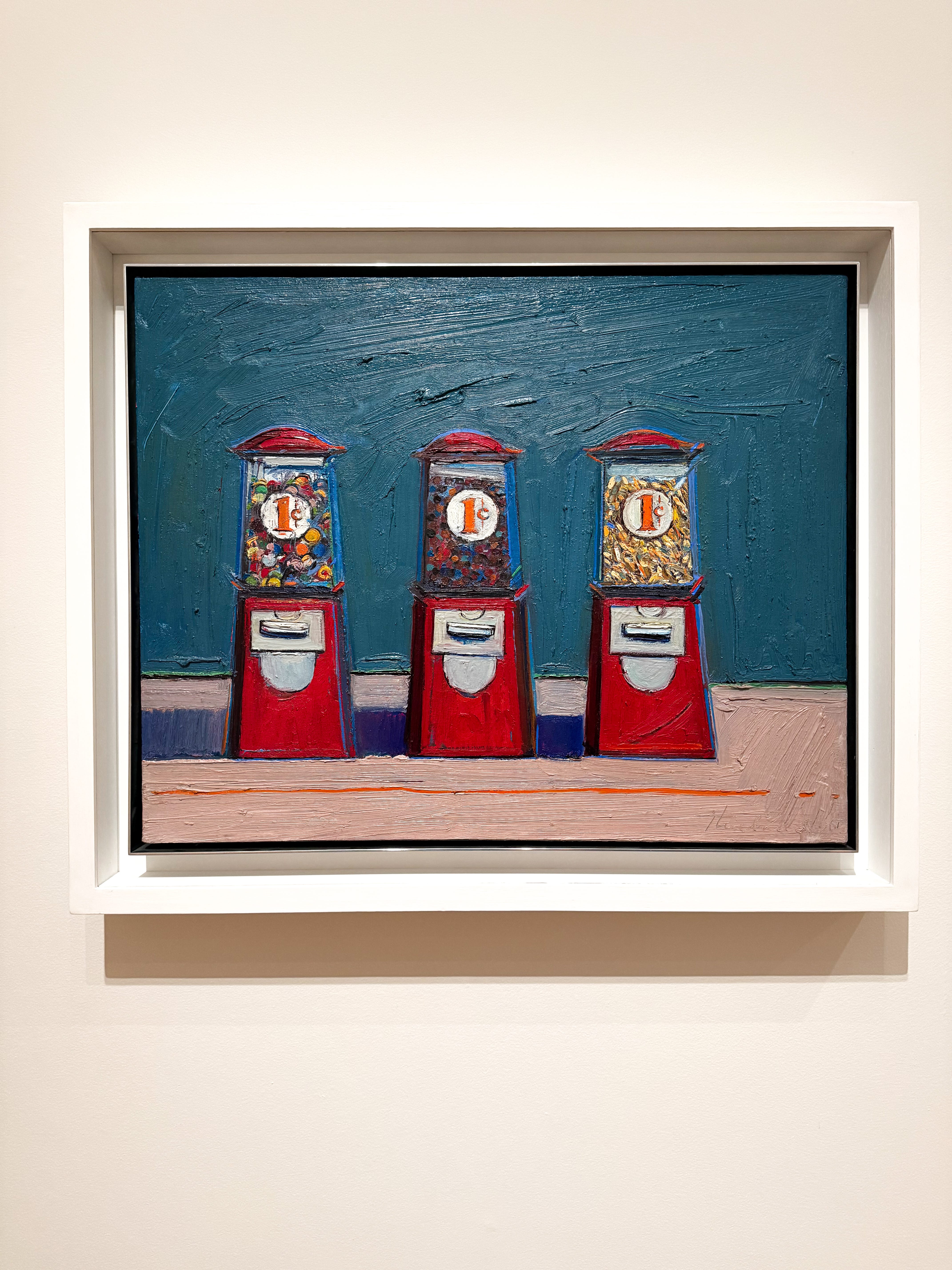
In this sense, the cultural boom of postwar America was not ornamental but strategic. Whether knowingly or not, Thiebaud’s work aligned neatly with this cultural project. At a time when the United States was invested in projecting itself as prosperous, free, and sophisticated, particularly in contrast to the austerity of the Eastern Bloc Thiebaud’s paintings offered a compellingly contrasting image of American life. This was abundance without chaos; excess without desperation; pleasure rendered with discipline.
His appropriation of European painting traditions plays a crucial role here. By drawing on Impressionism and Post-Impressionism, Cézanne, Degas, Bonnard, and applying those painterly languages to resolutely American subjects, Thiebaud effectively transferred cultural authority from Europe to the United States. Mass-produced desserts, diner counters, and suburban streets were granted the visual gravitas of high art.
This move legitimised Americana not just aesthetically, but culturally. It suggested that the United States was not merely economically dominant, but capable of inheriting, absorbing, and continuing Western art history. In this sense, Thiebaud’s work quietly participates in American cultural hegemony not through propaganda, but through normalisation.
His continued canonisation by major institutions only reinforces this. Thiebaud’s America is one where consumption, tradition, and artistic seriousness coexist seamlessly. That vision has proved remarkably durable.
Curation of Grotesque Perfection of Consumption
To read Thiebaud as offering an unedited portrait of American life, however, I think misses the point. His still lives are completely edited and curated. After all, Thiebaud worked as an art director and commercial illustrator. He understood selection, framing, emphasis. He knew exactly what to show and what to withhold. So to me, to understand what Thiebaud is trying to communicate through his art, we must pay extra attention to his composition, what he chooses to show, how he chooses to present it.
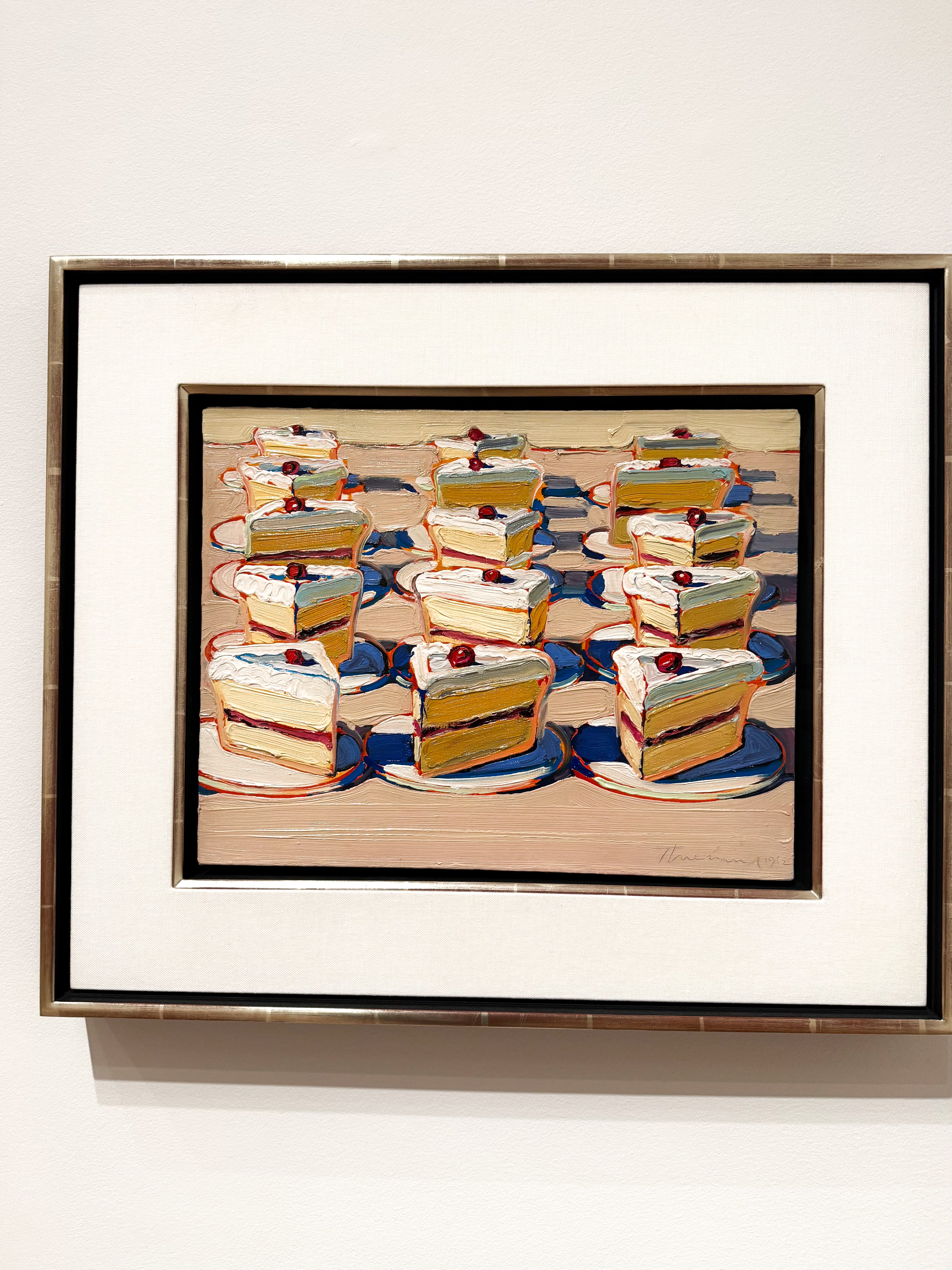
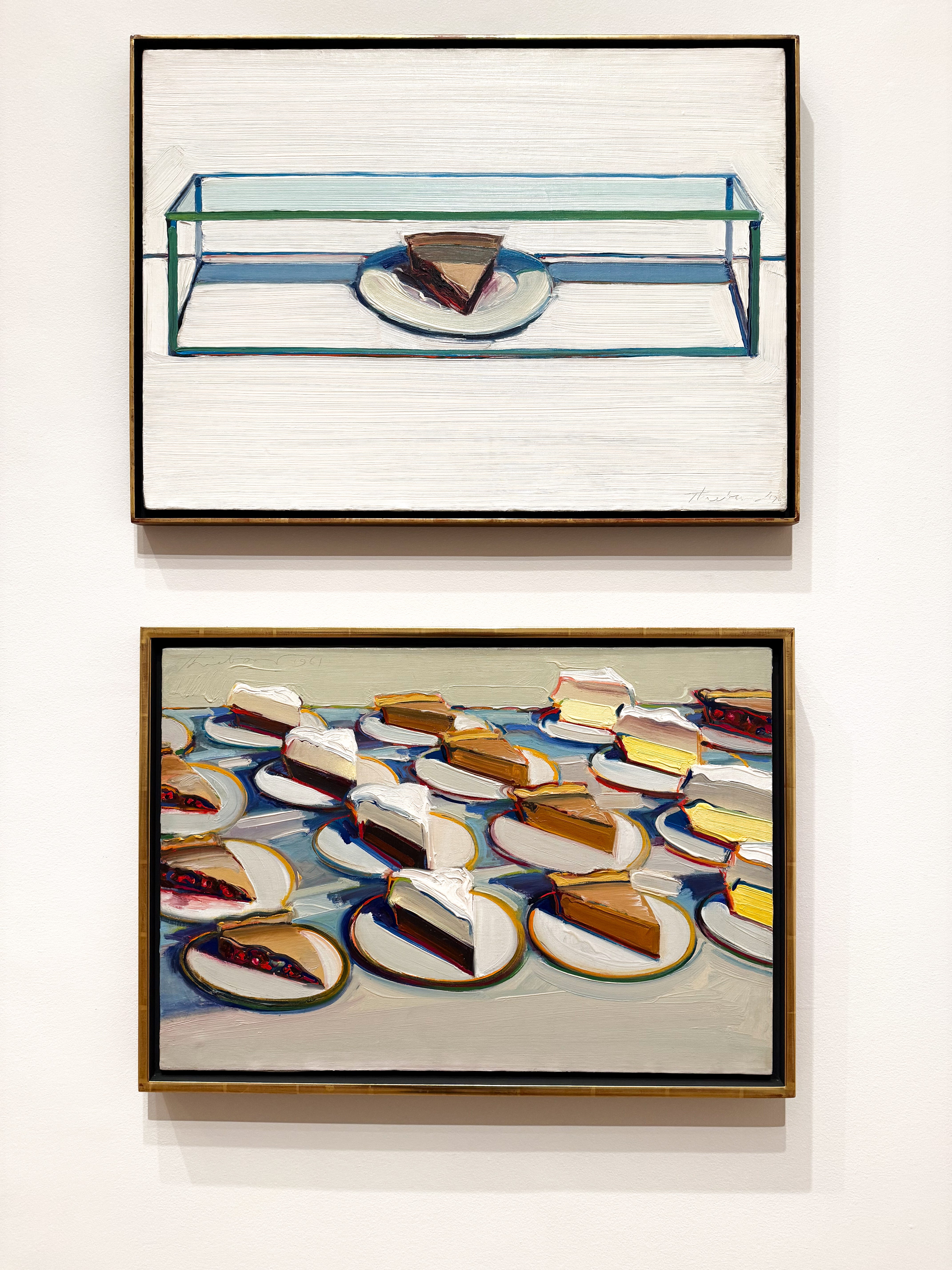
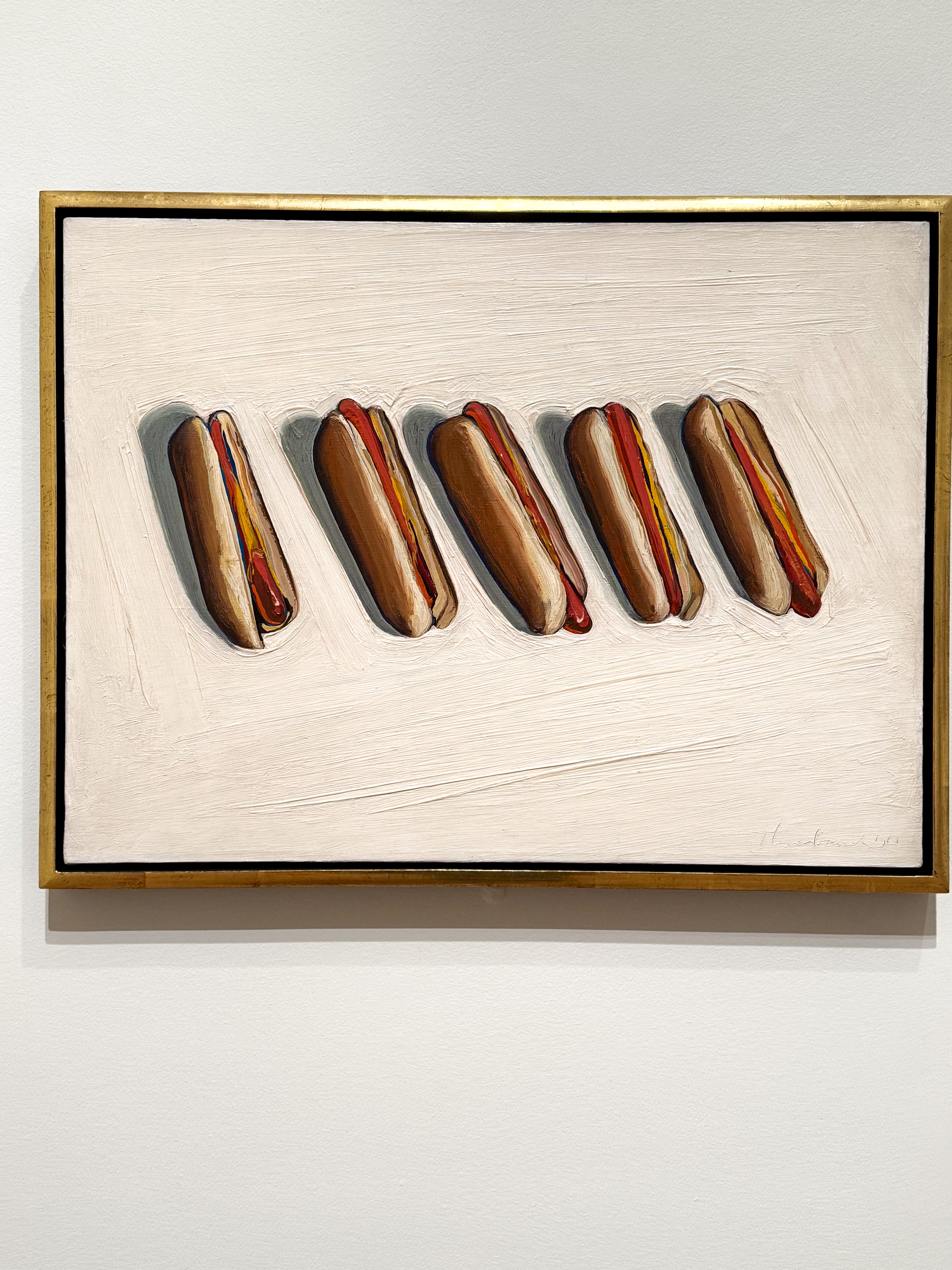
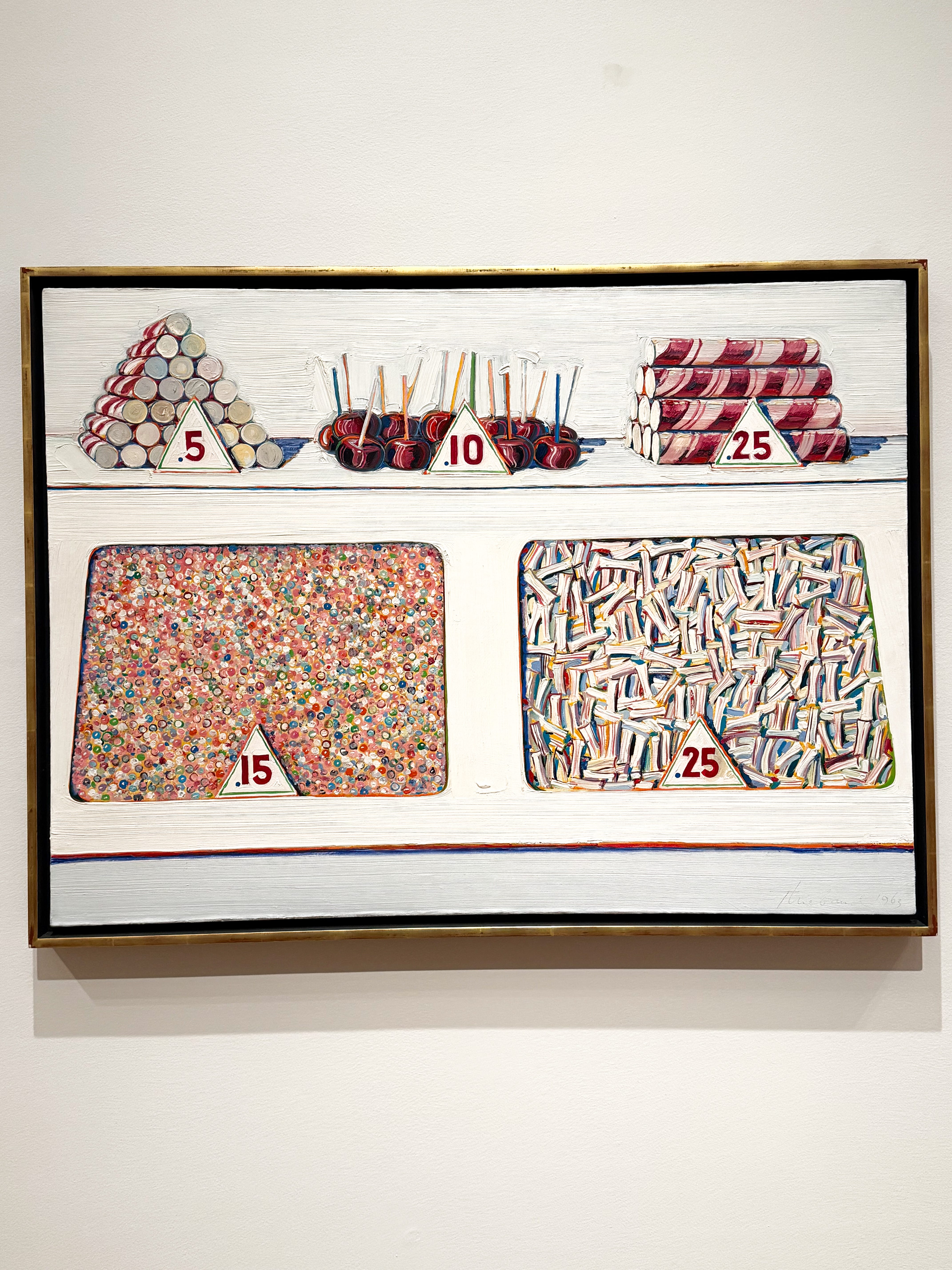
His work, overtly ornamental and celebratory has a tinge of cynicism and incredulity. What’s more compelling is that it never fully resolves into celebration. His paintings are unsettling for a reason. His subjects are almost always industrially processed foods, cakes, pies, hot dogs, ice creams, rendered with unnaturally high colour saturation and hyperbolic surface texture. The lemon meringue pie appears perfect to the point of menace. The icing on the cakes are over-piped. The colours are synthetic. The forms are eerily precise; pleasure tips into discomfort.
Unlike Warhol’s unopened cans, Thiebaud often decants his food. By doing so, even more so than Warhol, Thiebaud exposes their artificiality through grotesquely saturated greens and oranges in the cream soups. The illusion cracks.
Works such as Around the Cake, Half Cakes, and Four Pies in a Glass Case present food as venerated yet abandoned. They sit behind glass, stripped of warmth, labour, or human presence and labour that goes behind a diner. His counter paintings are devoid of hustle or human exchange. What remains are saccharine objects suspended in sterile stillness, gathering dust. There is a sense of abandonment. He shows how abundance lead to superfluity.
In serial works like Pie Rows and Five Hot Dogs, repetition becomes oppressive; abundance turns monotonous; perfection becomes futile. The overpiped cakes no longer signal indulgence, but excess emptied of meaning.
The Historian, Not the Iconoclast
Thiebaud was not an iconoclast in the way many of his contemporaries were. Artists like Johns, Rauschenberg, Warhol, and Sturtevant used appropriation as a strategy of disruption. Thiebaud did not. His engagement with art history was reverent rather than subversive.
He did not receive a traditional art education, but he was deeply committed to teaching and believed that painting was fundamentally communal. He spoke openly about the misconception that art emerges from isolated genius. Painting, for him, was layered, social, and historical; communal and something built collectively over time. Borrowing, in this sense, was not a tactic but a necessity. He saw himself as part of a lineage, not a rupture.
Thiebaud’s paintings may look sweet, but they are not innocent. They smile, perhaps, but it’s a knowing smile, one that lingers a tad too long enough to make you uneasy, to make it appear sardonic.
Thiebaud’s work sits comfortably, within the broader postwar project of American cultural consolidation. At a moment when the United States was intent on presenting itself as not only economically dominant but culturally authoritative, Thiebaud offered an image of America that was orderly, abundant, and aesthetically self-assured. His paintings translate mass-produced, everyday American objects into the visual language of European high art, effectively collapsing the distance between inherited cultural authority and contemporary American life. In doing so, they suggest that American consumer culture is not crude or provisional, but mature enough to absorb, reinterpret, and continue the traditions of Western painting. Thiebaud does not shout this argument; he stages it.
Through careful curation, painterly discipline, and reverence for art history, his work helps normalise the idea that the centre of cultural gravity has shifted westward, that the American diner counter, cake stand, or suburban street is now as legitimate a subject for serious painting as the European still life or café scene once was. Whether intentional or not, this positioning aligns seamlessly with the United States’ broader soft-power ambitions: to make American life not just visible, but culturally inevitable.
Great essay!